 Tampa Siding
 Siding Built for Valrico's Weather, Not Just Its Looks
Valrico sits inland from Tampa Bay in Hillsborough County, but "inland" doesn't mean sheltered. Homes here still take the full brunt of a Central Florida summer: afternoon thunderstorms that roll in almost daily from June through September, hurricane-force wind gusts during the worst storms, and UV exposure that runs nearly year-round. Add in the humidity that never really lets up and the occasional salt-tinged air carried in from the Gulf on a westerly breeze, and you've got a climate that is genuinely hard on exterior building materials — even ones marketed as "low maintenance."
We're a Tampa-based siding, roofing, window, and deck contractor, and Valrico is inside our regular service area. We're not a national chain routing crews through on a rotation — we're local, we know what this climate does to a house over ten or twenty years, and we install one siding product because we've seen what holds up and what doesn't.
What Hillsborough County Homes Are Actually Up Against
Heat and UV
Florida sun is relentless. Siding facing west or south in Valrico can see surface temperatures well above the surrounding air temperature on a summer afternoon. Over years, that kind of heat and UV load fades color, softens caulk and sealants, and stresses any material that wasn't engineered to handle it. Cheaper paint finishes chalk and fade faster than homeowners expect.
Wind-Driven Rain
Tampa's afternoon storms aren't gentle. Wind-driven rain doesn't just fall on siding — it pushes water sideways, into seams, laps, and fastener points. Siding that isn't installed with the right clearances, flashing, and butt-joint treatment will let moisture behind the cladding, and once moisture gets behind siding in Florida's humidity, it doesn't dry out quickly.
Hurricane and Tropical Storm Wind
Valrico isn't coastal, but it's not out of range either. Tropical systems moving through the Tampa Bay area bring sustained high winds and gusts capable of tearing loose siding that's improperly fastened or made from lightweight material. Wind resistance comes from both the product and the installation — a strong product installed loosely is still a liability in a storm.
Humidity and Pest Pressure
Year-round humidity keeps moisture in the air even between storms, which is exactly the environment that wood-based and wood-composite products struggle with — swelling, softening at cut edges, and susceptibility to termites and other wood-boring pests common to this part of Florida.
Why We Only Install James Hardie Fiber Cement
We used to get asked to install other products — vinyl, LP SmartSide, primed wood, other fiber cement brands. We stopped offering them, not because they're worthless products everywhere, but because we don't think they're the right call for what Hillsborough County homes go through. Here's the honest version of why:
- Vinyl siding is affordable and easy to install, but it's a petroleum-based product that softens and can warp in sustained high heat, and it's more vulnerable to cracking under wind-driven debris impact than fiber cement.
- Wood-composite siding (like LP SmartSide) uses engineered wood strand technology with a resin coating — a real improvement over old wood siding, but it's still wood at its core, and any breach in the factory coating (a deep scratch, an unsealed cut edge, a fastener installed wrong) gives Florida humidity an opening.
- Primed wood or cedar siding looks great initially but demands a repainting and caulk-maintenance cycle that most homeowners underestimate, especially under intense UV.
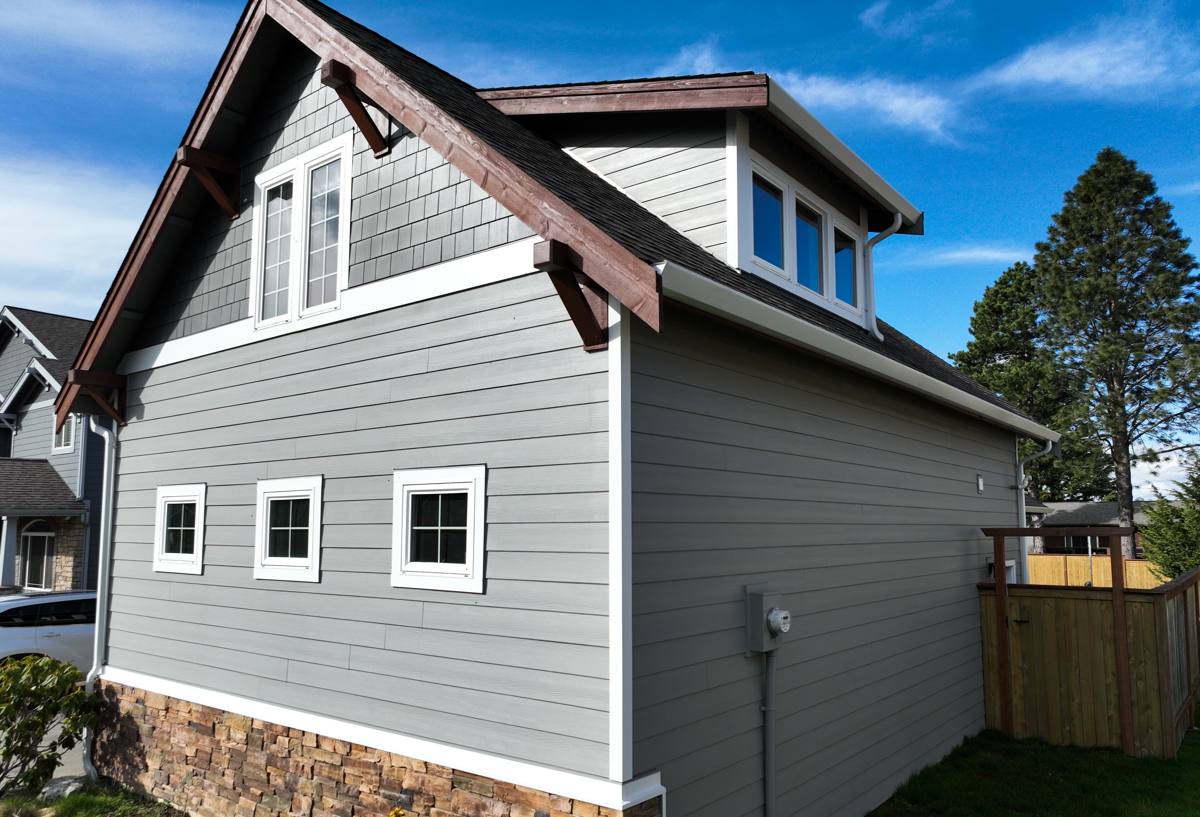
James Hardie fiber cement is cement, sand, and cellulose fiber — non-combustible, dimensionally stable, and not a food source for termites or other pests. It doesn't soften in heat. The ColorPlus factory-baked finish is engineered to resist UV fade far longer than field-applied paint, which matters enormously under Florida sun. And Hardie's HZ5 product line is specifically formulated for high-humidity, high-moisture climates like ours — it's not a generic product pulled off a national spec sheet.
Comparing the Common Options
| Factor | Vinyl | Wood Composite | James Hardie Fiber Cement |
|---|---|---|---|
| Heat/UV stability | Can warp, fades over time | Resin coat resists fade; core still wood-based | Baked-on ColorPlus finish, engineered for UV |
| Moisture/humidity behavior | Doesn't absorb, but seams can trap moisture behind it | Vulnerable at unsealed cuts and edges | Doesn't rot; HZ5 formulated for humid climates |
| Wind/impact resistance | Can crack or blow off in high wind if underrated | Solid, but panel edges are impact-sensitive | Dense, heavy, holds up well when correctly fastened |
| Pest resistance | Not a food source | Wood-based, treated but not immune | Not a food source for termites |
| Typical maintenance | Occasional wash | Caulk/seal touch-ups at seams | Periodic caulk check, no repainting for years |
How We Handle a Siding Project in Valrico
Assessment and Estimate
We start with a walk-around of the house — looking at current siding condition, moisture staining, soft spots (often around windows and low corners), and how the home is oriented to sun and prevailing wind. That tells us where the real wear is happening, not just where it's visible.
Tear-Off and Substrate Check
Once old siding comes off, we check the sheathing and house wrap underneath. This is the step some contractors skip — but in a humid climate, hidden water damage behind old siding is common, and covering it back up without addressing it just guarantees a repeat problem in a few years.
Weather Barrier and Flashing
Correct house wrap, window and door flashing, and butt-joint flashing are what actually keep wind-driven rain out — the siding itself is the second line of defense, not the only one. This is where a lot of siding failures actually originate, regardless of what product is on the wall.
Installation to Manufacturer Spec
James Hardie has specific fastening patterns, clearances from grade and roofline, and gapping requirements — all engineered around wind and moisture performance. Installing it "close enough" undercuts the product's actual warranty coverage and its real-world performance in a storm.
Final Walkthrough
We go over the finished work with the homeowner before calling the job done — trim lines, caulking, paint touch-up at any field cuts, and cleanup.
Beyond Siding: The Full Exterior Picture
Siding doesn't work in isolation. We also handle roofing, windows, and decks because a home's exterior envelope only performs as well as its weakest link. A few examples of how these connect:
- Roof edge and fascia condition affects how water sheds away from the top course of siding.
- Window flashing has to integrate correctly with the siding weather barrier, or you get leaks at the frame regardless of how good the siding itself is.
- Deck ledger boards attached to the house need proper flashing where they meet siding, a spot that's easy to get wrong and hard to notice until there's rot.
If we're already on-site for a siding job, we'll flag anything we see in these other areas — we're not going to sell you work you don't need, but we're also not going to ignore a problem we noticed while we're up on a ladder.
What a Siding Project Costs and What Drives the Price
Every home is different, and we don't post fixed prices because square footage, current siding removal complexity, trim detail, and home layout all move the number. In general terms, cost is driven by:
| Cost Factor | Why It Matters |
|---|---|
| Home square footage and stories | More surface area and access difficulty (ladders/lifts) increase labor |
| Tear-off scope | Full removal of old siding vs. simpler recover situations |
| Substrate repair needed | Rot or water damage found underneath adds material and labor |
| Siding profile and trim detail | Lap width, board-and-batten accents, and trim complexity affect labor time |
| Color/finish selection | Factory ColorPlus finishes vs. field-painted options |
We give real numbers after we've actually looked at the house — not a phone-quote guess.
Why a Local Crew Matters in Valrico
We're not driving in from out of state chasing storm work. Being based in the Tampa area means we're accountable if something needs a callback, we know which suppliers can actually get Hardie product and matching trim on short notice locally, and we understand how Hillsborough County's permitting and inspection process works so a project doesn't stall waiting on paperwork we didn't anticipate. It also means our crew has installed siding on plenty of homes built to the same general construction era and style common in Valrico and the surrounding Brandon/Tampa area, so we're not guessing at what's typically hiding behind the old siding.
Signs Your Siding Needs Attention
- Visible warping, buckling, or gaps between panels
- Soft spots when you press on the siding, especially near the bottom courses or under windows
- Paint that's peeling, bubbling, or chalking heavily to the touch
- Rising utility bills that might point to a compromised weather barrier
- Visible mold, mildew staining, or a musty smell near exterior walls
- Cracks or holes from storm debris impact
Any one of these is worth a look. Several together usually mean the siding system, not just the surface, needs attention.
If your Valrico home's siding is showing its age, or you're planning ahead of hurricane season, we're happy to come take a look. The estimate is free, there's no pressure, and you'll get a straight answer about what your home actually needs — use the form below to get started.